Thursday, July 4, 2019

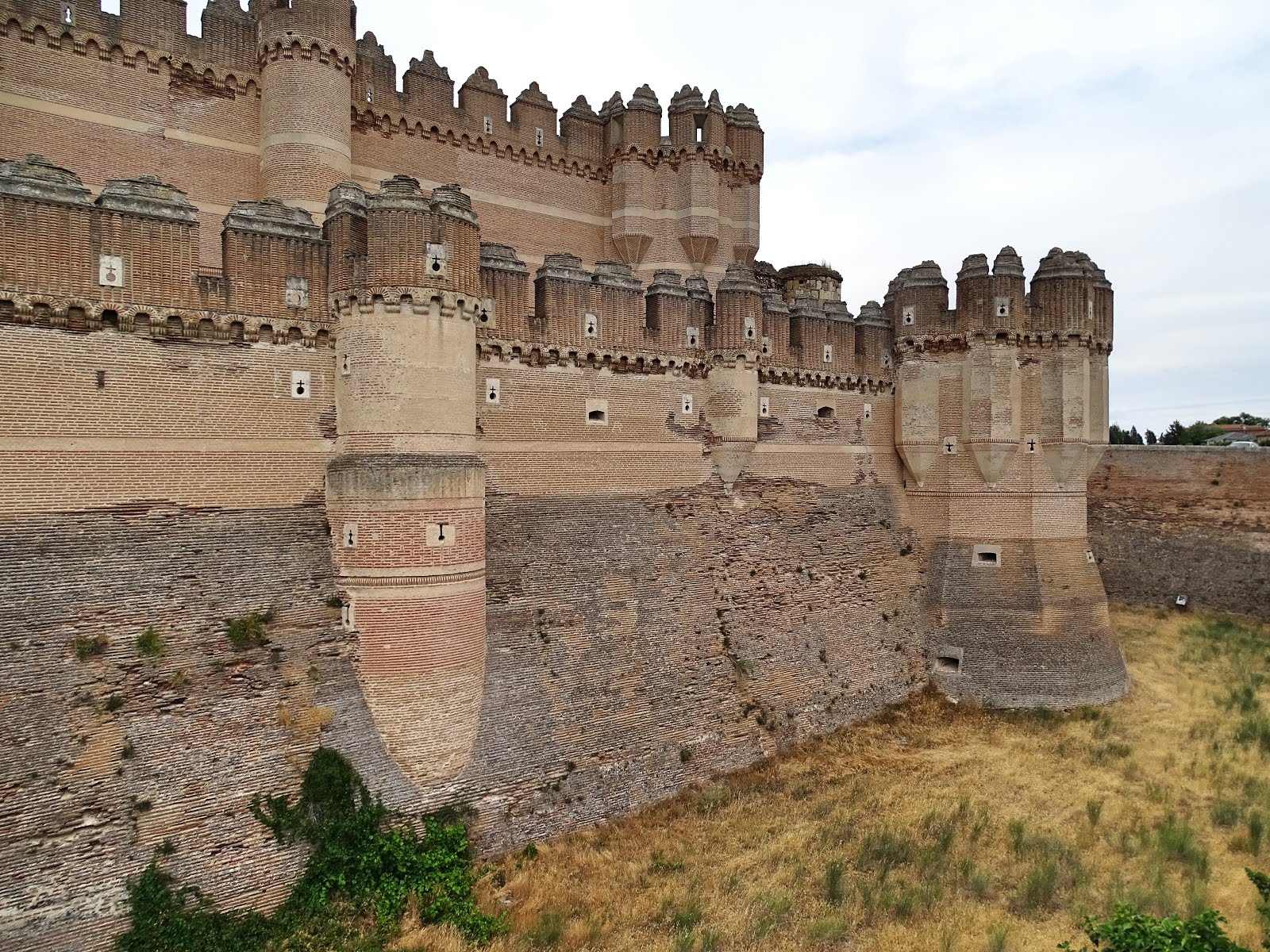
Coca Castle Moat


From books and movies, I had a standard concept of a castle that includes a moat. Here is a short description of moats from Wikipedia: Moat.
A moat is a deep, broad ditch, either dry or filled with water, that is dug and surrounds a castle, fortification, building or town, historically to provide it with a preliminary line of defence. In some places moats evolved into more extensive water defences, including natural or artificial lakes, dams and sluices. In older fortifications, such as hillforts, they are usually referred to simply as ditches, although the function is similar. In later periods, moats or water defences may be largely ornamental. They could also act as a sewer.
 I guess my idea of moats and castles changed dramatically the moment I realized I was looking at a real castle and a real moat. This is Coca Castle in Spain. The moat is about 60 to 70 feet deep and was probably filled with water at some time. I have revised almost all I have seen about castles from movies. What you might have seen is mostly fantasy.

Wednesday, July 3, 2019

The Royal Palace at La Granja de Ildefonso


I can only take so much gold and statues. Palaces are mostly all ostentatious. This is the summer palace of the kings of Spain one of seven or so palaces around the country. I am comfortable living in a tent so moving up to a palace would be more overhead than I could take. Interestingly, they won't let you take photos inside the palace but I do find a lot of interior photos online. I guess you have to apply to take photos and have an appointment or whatever. I did like the garden.

Storks in Spain


The White Stork, Ciconia ciconia, is ubiquitous in Spain. You need to look for their nests on tall structures such as this old smoke stack and on church spires. They are very graceful flyers and because of their large size, they are very noticeable. Their counterparts in the United States are the blue herons that seem to have spread over most of the country in the last 50 years.

Tuesday, July 2, 2019

The Beginning of the Aqueduct in Segovia, Spain


Technically, this is not the start of the famous Aqueduct in Segovia, Spain, but it is the start of the part that is most recognizable. The Aqueduct really started high up in the mountains many miles from the city. The water channel is the square dark spot on the blocks at the end. The entire structure was engineered to the right slope to carry the water all the way through the city. We walked the entire length of this preserved part of the Aqueduct.

It is prohibited to post bills


It is common in many countries to advertise events by posting (gluing or taping) bill (signs or posters). This is true in Spain. However, here is a posted notice saying that it is prohibited to post notices or bills or posters. In addition, there is another item posted on top of the notice. This says two things: the notice is being disregarded and apparently there are some exceptions to the no posting rule. These postings are so common, they are likely ignored for the most part unless they have some political or commercial value.

Detail from the Alhambra, Granada, Spain


It is hard to imagine the artistic effort that went into the construction of the Alhambra in Granada, Spain. Here is a short summary of the work:
The decoration consists for the upper part of the walls, as a rule, of Arabic inscriptions—mostly poems by Ibn Zamrak and others praising the palace—that are manipulated into geometrical patterns with vegetal background set onto an arabesque setting ("Ataurique"). Much of this ornament is carved stucco (plaster) rather than stone. Tile mosaics ("alicatado"), with complicated mathematical patterns ("tracería", most precisely "lacería"), are largely used as panelling for the lower part. Similar designs are displayed on wooden ceilings (Alfarje).[4] Muqarnas are the main elements for vaulting with stucco, and some of the most accomplished dome examples of this kind are in the Court of the Lions halls. The palace complex is designed in the Nasrid style, the last blooming of Islamic Art in the Iberian Peninsula, that had a great influence on the Maghreb to the present day, and on contemporary Mudejar Art, which is characteristic of western elements reinterpreted into Islamic forms and widely popular during the Reconquista in Spain.
See Wikipedia: Alhambra.

Monday, July 1, 2019

The Alhambra


There are some places in the world that defy description. The Alhambra in Granada, Spain is one of those places. No matter how many photos you see of the place or how many descriptions you read, you simply cannot imagine the tremendous amount of work and design that went into this huge structure and the surrounding gardens. Here is a short introduction from Wikipedia: Alhambra that will get you started.
The Alhambra (/ælˈhæmbrə/; Spanish: [aˈlambɾa]; Arabic: الْحَمْرَاء‎ [ʔælħæmˈɾˠɑːʔ], Al-Ḥamrāʾ, lit. "The Red One") is a palace and fortress complex located in Granada, Andalusia, Spain. It was originally constructed as a small fortress in AD 889 on the remains of Roman fortifications, and then largely ignored until its ruins were renovated and rebuilt in the mid-13th century by the Nasrid emir Mohammed ben Al-Ahmar of the Emirate of Granada, who built its current palace and walls. It was converted into a royal palace in 1333 by Yusuf I, Sultan of Granada.[1] After the conclusion of the Christian Reconquista in 1492, the site became the Royal Court of Ferdinand and Isabella (where Christopher Columbus received royal endorsement for his expedition), and the palaces were partially altered in the Renaissance style. In 1526 Charles I & V commissioned a new Renaissance palace better befitting the Holy Roman Emperor in the revolutionary Mannerist style influenced by humanist philosophy in direct juxtaposition with the Nasrid Andalusian architecture, but it was ultimately never completed due to Morisco rebellions in Granada.