Wednesday, November 17, 2021

Pipes and Rocks in Kodachrome Basin


Unusual rock formations appear in pockets around southern Utah. This is part of what is known as Kodachrome Basin. The thin tall structures are pipes whose origin is disputed. The sandstone cliffs are ubiquitous but the pipes are only found within Kodachrome Basin State Park or in the immediate surrounding area. There are some trails up along the tops of the sandstone ridges but these trails are not for anyone suffering from a fear of heights.  

Tuesday, November 16, 2021

Time Travel through rocks


Each of these Southern Utah rock layers took millions of years to form. 


Kodachrome Basin State Park is located on the Colorado Plateau, an uplifted region that covers much of the four corners area of Utah, Arizona, New Mexico and Colorado. Within the park, the exposed formations range from the middle Jurassic Period (180 million years ago) to the Cretaceous Period (95 million years ago). Here is a description of the layers from a Kodachrome State Park Brochure:
Carmel Formation: Deposits from an inland sea that existed 180 million years ago formed this layer. This is the oldest exposed formation in the park. The Carmel Formation is characterized by solid layers of the mineral gypsum, which forms white striations in the red colored cliffs in the lower elevations of the park.

Entrada Formation: Lying just above the Carmel Formation is the red colored Entrada. The Entrada was formed from deposits that were laid down during the mid-to-late Jurassic Period, approximately 180 to 140 million years ago. It is primarily composed of fine grained sandstone along with gypsum, shale, quartz and clay. This formation is one of the most scenic in the park due to its color. It also forms the ubiquitous “slickrock” of southern Utah. Most of the sedimentary pipes found within the park occur in this formation.

Henrieville Sandstone: Deposited near the end of the Jurassic Period, the Henrieville Sandstone is white to tan in appearance. Deposits of Henrieville Sandstone are almost unnoticeable in the main part of the park. However, Grosvenor Arch, located approximately 11 miles south of the park, was formed within this sandstone.

Dakota and Tropic Shale Formations: These are the uppermost formations visible in the park. They were deposited approximately 95 million years ago when a vast seaway covered much of the interior of North America, including most of Utah.

Saturday, November 13, 2021

Sandstone and Pipes


 The formations that look like pillars are called "pipes" and how they formed is a mystery. They are not composed of of the same sandstone as the surrounding rocks, they are intrusions of a harder conglomerate. You can read more about this landscape with this article called, "Clastic Pipes and Dikes in Kodachrome Basin", by Ariel A. Roth. 

Friday, November 12, 2021

The Land of Rocks and Sky


Southern Utah is the land of rocks and sky. Almost everywhere you turn off of the freeways and highways you will find places that seem so different as to be almost alien landscapes. This sense of the unreal has been used hundreds of times for movies that depict alien worlds. If you need a sense of dislocation, there is an almost endless variety of places to visit. 

Tuesday, November 9, 2021

A Model Ship


Rijksmuseum, Amsterdam, the Netherlands

I am fascinated with the time and effort it took the builders to build these fabulous model ships. These models were made to scale and were used to build the actual ship. In most cases, the models you see in the museums of sailing ships were part of the plans and promotion to raise money to build the ship. Military ships were no exception. It is interesting because a few of the model ships never became full-scale ships due to failure to raise the money or changes in plans by the governments. We have seen some very impressive collections of model ships in the Naval Academy Museum in Annapolis, Maryland, the Smithsonian National Museum of American History in Washington, D.C., and the Rijksmuseum in Amsterdam, the Netherlands. 

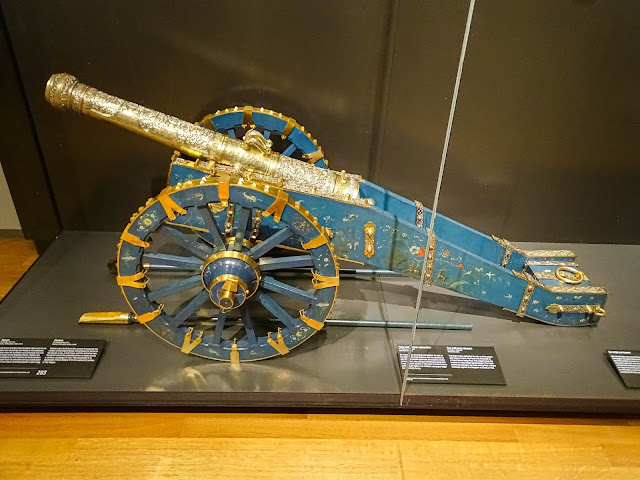
Gilded Model Cannon


This is a gilded model cannon from the Rijksmuseum in Amsterdam, the Netherlands. It is dated to around 1745. There is some measure of controversy with this and other objects because they are accused of being obtained by military actions during the Dutch Empire. I think of all the, perhaps, millions of objects in many of the museums in the world that were obtained during conflicts. It is just one of those issues that keep smoldering out there in the world like U.S. Civil War statues. 

Friday, November 5, 2021

Chainmail


This is chainmail from the Rijksmuseum in Amsterdam, The Netherlands. I cannot imagine how heavy this was to wear. Here is a very brief explanation about this form of protection from Wikipedia: Chain mail.
Chain mail (often just mail or sometimes chainmail)[1] is a type of armour consisting of small metal rings linked together in a pattern to form a mesh. It was generally in common military use between the 3rd century BC and the 16th century AD in Europe, and longer in Asia and North Africa. A coat of this armour is often referred to as a hauberk, and sometimes a byrnie.