Living right next to the National Forest has its distinct advantages but there are always disadvantages. In this case, the chainlink fence is not enough, by itself, to stop deer. This fence is only about six feet high and deer can jump over it easily. The idea of the wood in the fence is to make the deer think more than twice about trying to jump. The wood provides an uneven and hard to judge surface. I have no idea if this works because it is not my fence, but it looks interesting nonetheless. We have a herd of about seven or eight deer that come to our yard area almost daily. They will eat an amazing variety of plants and so if we want flowers or other plants, we have to plant what the deer won't eat.
Monday, June 15, 2020
Sunday, June 14, 2020
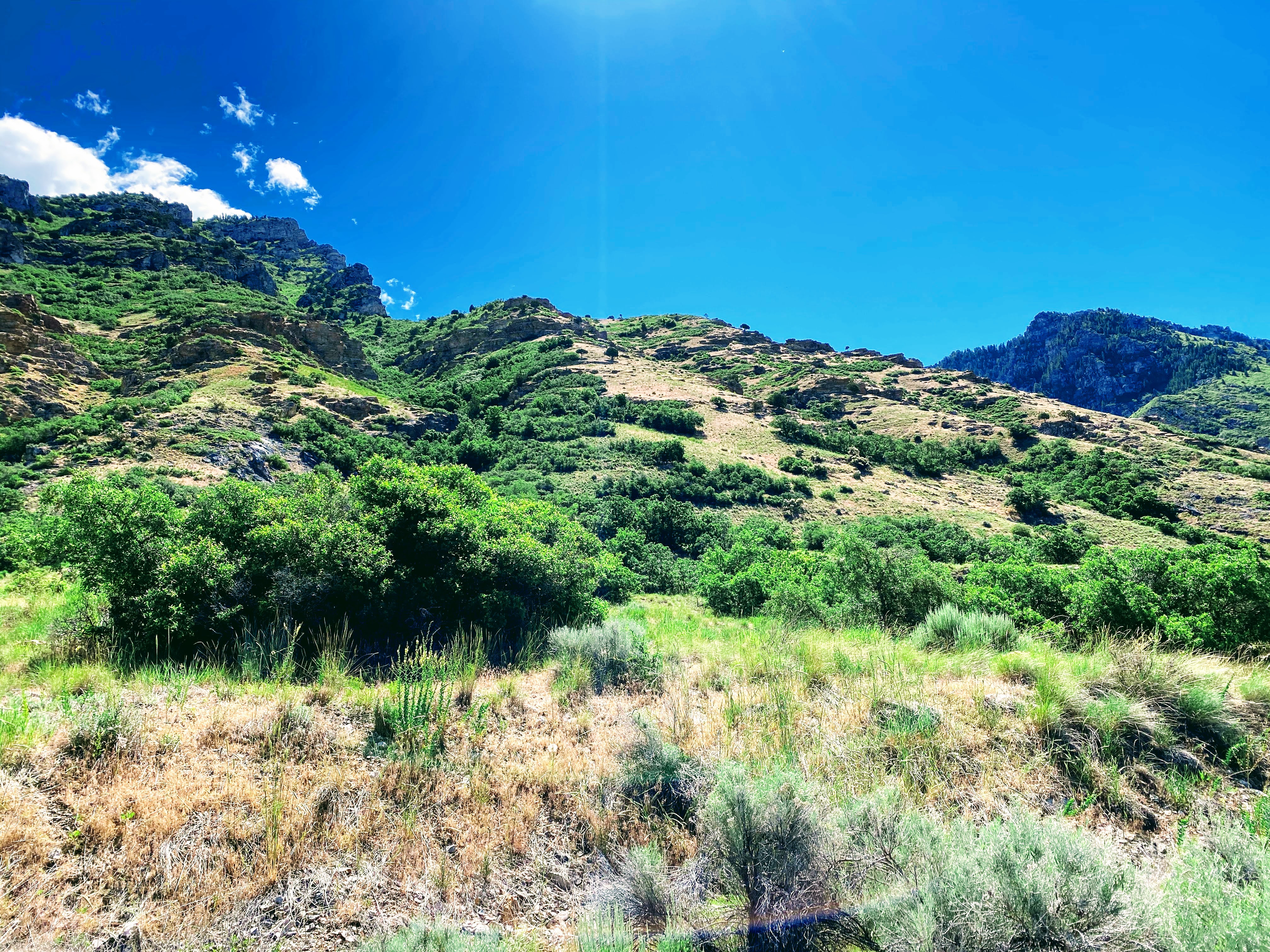
Wasatch Mountain Hillside
This is a close-up shot of the Wasatch Front just uphill from our house in Provo, Utah. Here is a little bit more about the Wasatch Mountain Range from Wikipedia:
The Wasatch Range (/ˈwɑːsætʃ/ WAH-satch) is a mountain range in the western United States that runs about 160 miles (260 km) from the Utah-Idaho border south to central Utah. It is the western edge of the greater Rocky Mountains, and the eastern edge of the Great Basin region. The northern extension of the Wasatch Range, the Bear River Mountains, extends just into Idaho, constituting all of the Wasatch Range in that state.In the language of the native Ute people, Wasatch means "mountain pass" or "low pass over high range." According to William Bright, the mountains were named for a Shoshoni leader who was named with the Shoshoni term wasattsi, meaning "blue heron".
This image shows what the mountains look like when they are green. Most of the time, the green part is usually brown except for the trees.
Saturday, June 13, 2020
Provo Temple and Utah Valley
The Provo, Utah Temple of The Church of Jesus Christ of Latter-day Saints is located on a prominent hillside on the east side of the city. This photo was taken from the Bonneville Shoreline Trail high above the city on a beautiful sunny spring day. The big structure in the background is LaVelle Stadium on the Brigham Young University campus. Further in the background is the huge expanse of Utah Lake, one of the large freshwater lakes in the United States at 151 square miles.
Friday, June 12, 2020
Along the Provo River
You could drive through Provo, Utah, and never know that it had a river running through the city. In fact, you could live here for quite a long time before realizing that there was a river running through the city. There are very few places where you can easily see the river unless you get out of your car and walk. This is due to a thick growth of trees along the river. Scenes like this one are only a few feet away from houses and roads with significant traffic. In fact, this image is only a few hundred yards from a large mobile home park. The entire river where it runs through the city is bordered by a paved walking and bike trail. For most of the trail, you are completely sheltered from the development on a short distance away. It is mostly an illusion but a very pleasant and beautiful one.
Thursday, June 11, 2020
Walking the Bonneville Shoreline Trail
The Bonneville Shoreline Trail will eventually stretch from the Idaho state line on the north to Nephi, Utah, approximately 280 miles. The stretch shown in the image above is on the east side of Provo, Utah just above the 5000-foot level. The Trail is named for Lake Bonneville, a huge pre-historic lake the filled the valleys of the Great Basin. See http://www.bonnevilleshorelinetrail.org/
Wednesday, June 10, 2020
Early morning in Utah Valley
We live just a few minute's walk from the Wasatch Front mountains. The mountains that make up this dramatic range soar up to almost 12,000 feet above sea level. One effect of living so close to the mountains is the sun does not rise above the mountains until long after the official sunrise time. We can watch the shadow of the mountains disappear eastward as the sun progresses each day. In the middle of the Winter, at our house, the sun only makes it above the ridges for a few minutes each day. We enjoy the shade of the mountains in the summer but we also live where the snow almost never melts when it is cold.
Tuesday, June 9, 2020
Yellow and Blue
It seems that most peoples opinion about flowers corresponds to how they feel about a lot of things in life; essentially, that more is better. People will travel across the world to see huge fields of tulips and rose gardens and other huge displays of flowers. But in a recent walk in the mountains, I realized the joy that comes from seeing the small individual flowers. The mountain wildflowers bloom all summer and into the fall. There are always new ones to enjoy. We have a statement that has always been on display in our house: "Bloom where you are planted." Maybe it is good to enjoy what we have around us rather than always seeking more.
Subscribe to:
Posts (Atom)